

The Lantern Path - Step Three
SURRENDERING
to the flow
Learning when to steer, when to soften, and when to let the current carry you.
ALLOW 60-75 MINUTES · JOURNAL & HEADPHONES NEARBY · MOVE IN YOUR OWN TIME
A note before you begin
__________________
Before expansion, attend to foundation.
Before looking toward what may open during our time together in Patonga, begin with where you are.
You are arriving here from a life already in motion: from relationships, responsibilities, decisions, joys, unfinished conversations, ordinary routines and perhaps a few things you have learned to carry without pausing to notice them.
Rooting is an invitation to turn toward that life with a little more curiosity. Nothing needs to be sorted out before ceremony. This is simply a chance to take stock of where you are, what you have been carrying, and what may be asking for your attention as we move closer to our time together.
There may be places in your life that feel deeply nourishing. Others may feel tender, crowded, uncertain or even depleted. Most seasons contain more than one truth at once.
Move slowly enough to notice yours.
This is not an exercise in excavation. You don’t need to search for problems or follow every thread that appears. Simply allow what is already here to come into view.
For now, that is enough.

Paying attention is a form of reciprocity with the living world, receiving the gifts with open eyes and open heart.
Robin Wall Kimmerer, Braiding Sweetgrass
Why begin here?
Because the conditions matter.
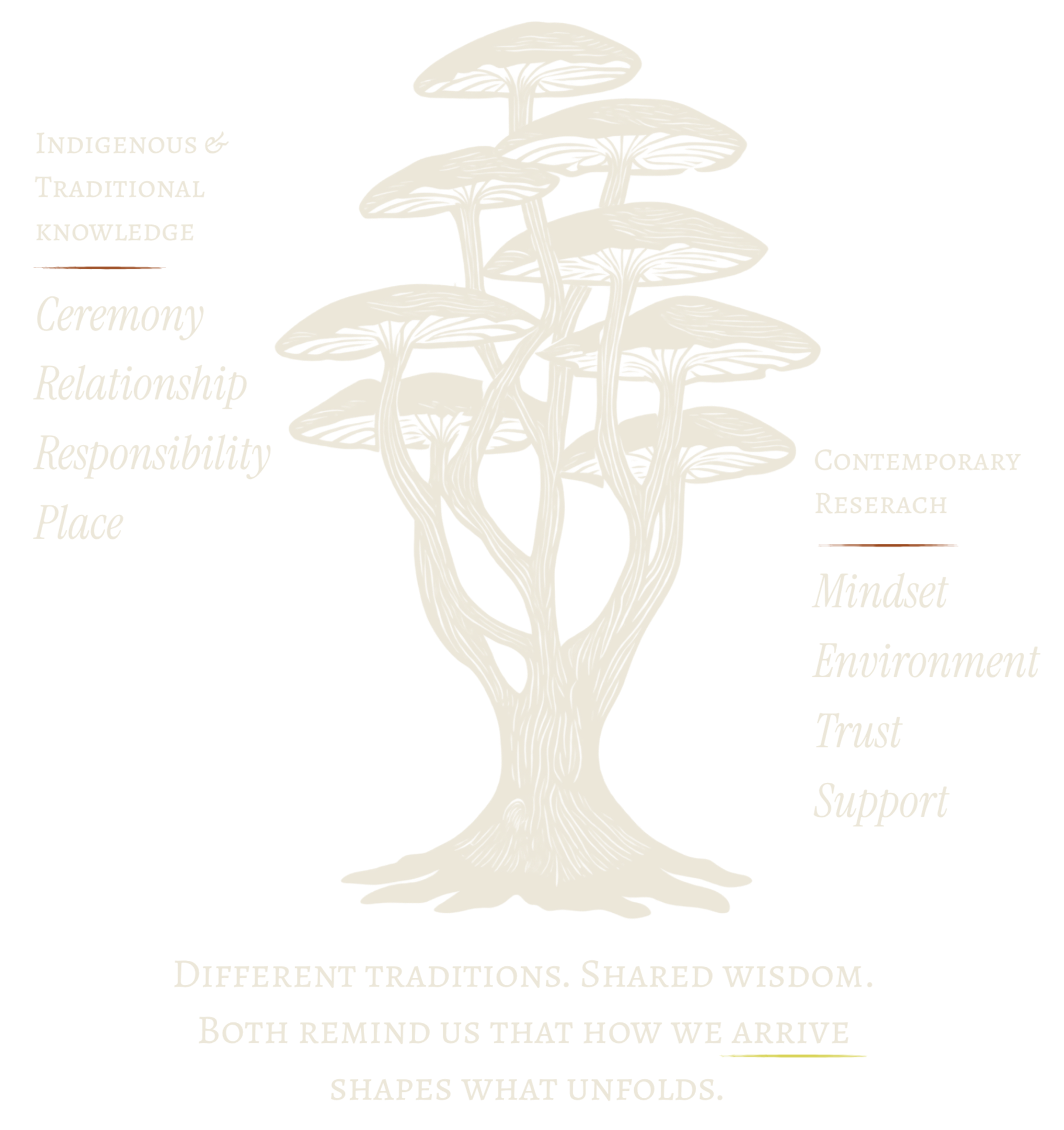
Across many Indigenous and traditional cultures, psychoactive plants and fungi have long been held within distinct traditions of ceremony, relationship, responsibility, and place.
Contemporary research uses a different framework, but it too recognizes that mindset, environment, trust, and support can meaningfully shape an experience.
These ways of knowing are not the same. But they share an attention to the context in which an experience unfolds.
Rooting begins there: paying attention to how we are arriving, and what is already surrounding us.
There are seasons of expansion and seasons of conservation, of flowering, shedding, repair, dormancy and growth beneath the surface.
The landscape is always responding to change.
We are seasonal creatures, too, even when our lives expect consistency from us.
For now, simply notice the season you are living within.
Take inventory of what is here.
Honor the season you’re in.
A tree does not meet every season in the same way.
REFLECTION FOR YOUR JOURNAL
If you didn't need to make this season sound manageable, impressive or resolved, what would you say is actually true about it?
What is bringing you joy?
What is demanding something from you?
What feels tender?
What has had very little room to speak?
Don't try to make the answers agree with one another.
More than one thing can be true.

Before you continue, look away from the screen.
A SMALL PAUSE
Find one piece of the living world around you: a plant, a tree beyond the window, the sky, moving water, an animal, even the changing light.
Stay with it for a few breaths. Notice what shifts when the only invitation is to be here.
TWO VIEWS OF THE SAME LIFE
What is visible…
and what is less seen.
Every life has a visible layer: the roles you inhabit, the people and places you care for, the ways others rely on you and the parts of life that can be measured, explained or seen.
Beneath the surface is another view: the felt experience of living that life: what nourishes you, what asks something of you, what you need, and what may be harder to name.
Neither tells the whole story on its own.
Psychedelic experiences can bring into view things we don’t consciously notice so clearly… feelings, memories, patterns, or ways of knowing that tend to sit just beneath everyday awareness. I think of it a little like the tide pulling back, revealing parts of the shoreline that were there all along. This practice simply helps you become a little more familiar with that inner landscape before ceremony.
Divide a fresh page into two columns. Label them:
Above the Surface ┃Beneath the Surface
Move through the prompts below without trying to make either side look better, clearer or more resolved than it is.
Above the Surface
What is taking shape around you
What is working, growing or feeling alive?
What is receiving most of your time and energy?
What roles or responsibilities are shaping your days?
What feels steady or well supported?
Beneath the Surface
What it feels like from within
Where do you feel most like yourself right now?
Where do you feel stretched, uncertain or tired?
What feeling or need has had little room ?
What longing keeps returning?

STEP BACK AND LOOK AT BOTH SIDES TOGETHER
Where do they tell the same story?
Where do they tell different ones?
What becomes clearer when you hold both at once?
You do not need to close the distance between them. For now, simply notice what is there.
A GUIDED PRACTICE · 20 MINUTES
What the Body Knows
There are things the body recognizes before the thinking mind has found words for them.
Through breath, gravity and the imagery of roots and mycelium, this meditation invites you to settle into the support already beneath you and listen to the body’s softer language: warmth, tension, heaviness, ease, movement or stillness.
Find a place where you can sit or lie down comfortably. Silence your notifications. If it feels supportive, close your eyes or soften your gaze, and allow the surface beneath you to carry some of your weight.
Headphones are strongly encouraged.
Settle
〰️
Descend
〰️
Listen
〰️
Settle 〰️ Descend 〰️ Listen 〰️

WHEN THE MEDITATION ENDS
What did you notice when you allowed the ground to carry some of your weight?
Notice what remains before trying to understand it.
Perhaps a sensation. An image.
A feeling. A word. A memory.
Or perhaps simply quiet.
Remembering the Way Back
A TEACHING ON STEADINESS
We sometimes imagine steadiness as calm: a quiet mind, an easy body, a sense that nothing is pulling us too far in any direction.
But steadiness is not the absence of movement.
It is knowing how to stay in relationship with yourself while something is moving through you.
Under pressure, most of us have familiar ways of responding. We may think harder, move faster, tighten our grip, take care of everyone else, withdraw, distract ourselves, or search for an answer.
These responses are not problems to eliminate. Many of them have helped us navigate uncertainty before.
This matters in ceremony, too. If an experience becomes intense, the goal is not to remain perfectly calm. Becoming familiar with your own signals, and what helps you return, can make it easier to stay connected to yourself as the experience moves.
The invitation here is simply to notice your patterns: when they begin, what they may be trying to do for you, and what helps you find your footing again.
Your way back may live in your breath. In movement. In another person. In music, water, quiet, touch, humor, prayer, the natural world, or something entirely your own.
Steadiness grows each time you remember where return is possible.
A CLOSER LOOK
Notice What Happens Under Pressure
Return to your journal and explore:
What do you instinctively reach for when things feel uncertain or hard to navigate?
01
Speed? Analysis? Productivity? Humor? Caretaking? Withdrawal? Distraction? Escape? Control?
What is that response trying to do for you?
02
What are the earliest signs that you are nearing the edges of your capacity?
03
Shallow breath? Tightness? Racing thoughts? Irritability? Numbness? An urge to withdraw, please, fix, or control?

Pause for one breath. Feel the places where your body is being supported. Let your exhale become a little longer than your inhale. Name one thing that tells your body: I am here. Then name one form of support available to you now, however small.
Find your way back, here.
TRY IT NOW
THE GROUND THAT HOLDS YOU
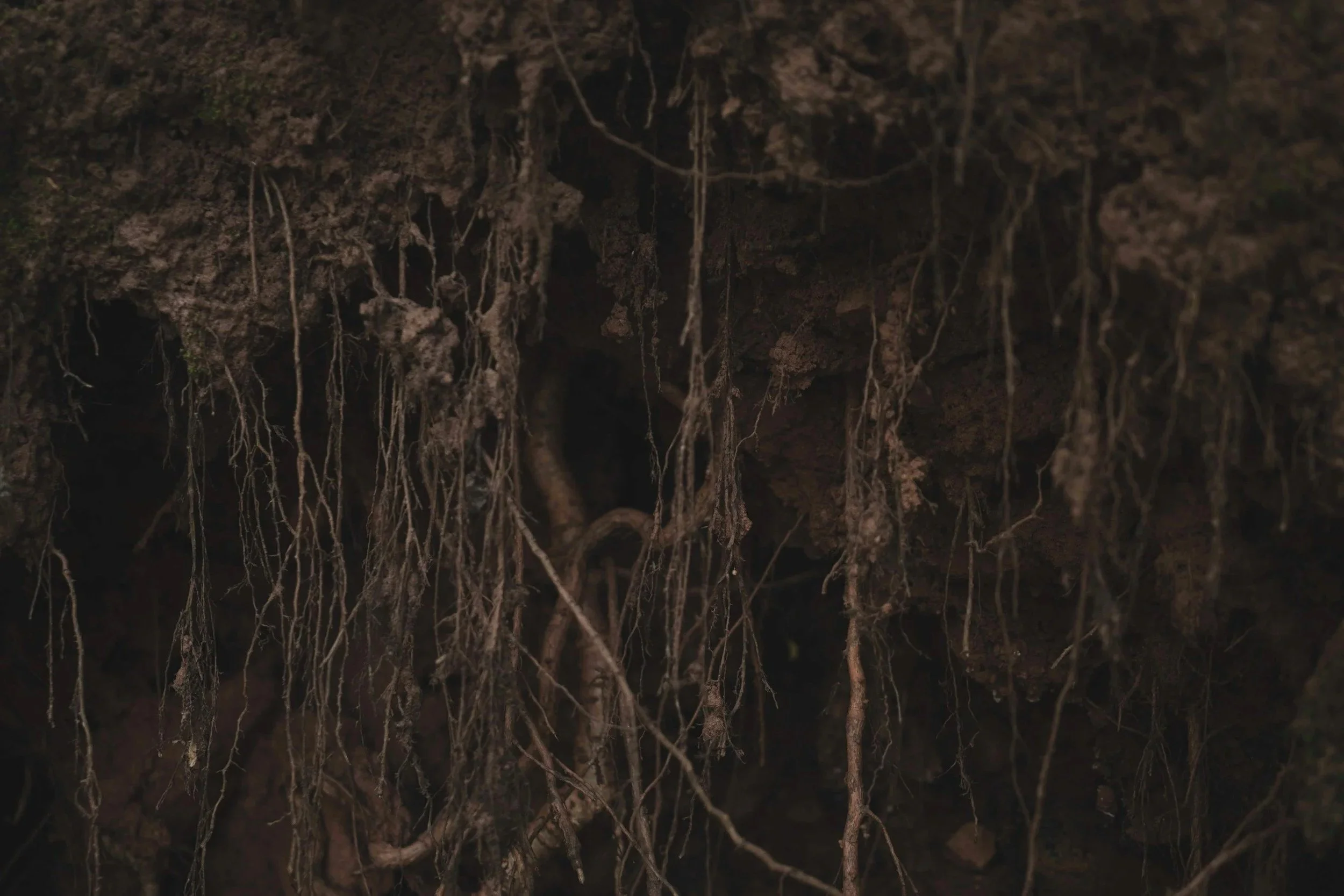
Roots do not sustain themselves in isolation.
They live in relationship with soil, water, weather, fungi, stone and the larger systems around them.
We are relational, too.
Being rooted does not mean needing nothing. It means knowing where support lives, what helps you return to yourself, and where you may be carrying more alone than you need to.
A PRACTICE OF SUPPORT
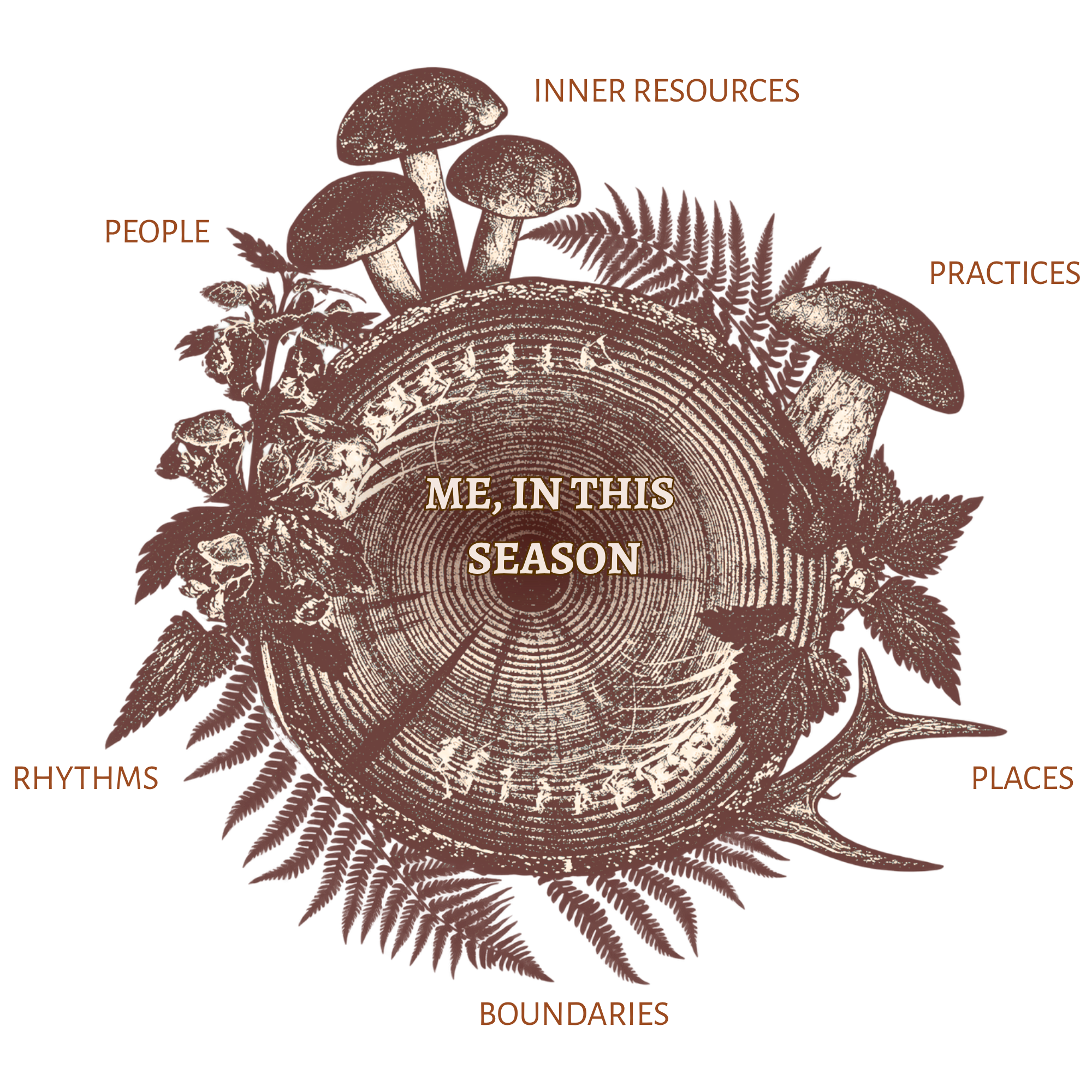
Map your root system.
On a fresh page, write ME, IN THIS SEASON at the center. From there, draw lines (or roots) toward the people, places, practices, rhythms, boundaries, and inner resources that genuinely support you.
Don’t draw the support system you think you should have. Map the one that actually exists.
BOUNDARIES
What protects your capacity?
INNER RESOURCES
What qualities in you have carried you through uncertainty before?
RHYTHMS
What helps keep you resourced over time?
· sleep · movement · nourishing food · quiet · time outdoors · unhurried time ·
PEOPLE
Who can you be real with?
PLACES
Where does your body soften?
PRACTICES
What reliably helps you return when you’ve been pulled away?
· breathwork · yoga · prayer · journaling · meditation · music ·
When you step back from the page, what do you notice about the way you are being held?
LOOK AT THE WHOLE SYSTEM
NOTICE
Which roots feel strong right now?
Which roots could use a little more care?
Where could your roots reach toward more support?
Nurture one root.
ONE SMALL ACT
Preparation does not have to mean doing more.
Sometimes it means tending one thing that already supports you.
A conversation. More sleep. Asking for help. Clearing something unnecessary from the calendar. Time outside. A meal that actually nourishes you. Returning to a practice you’ve drifted from.
What is one root you could tend between now and ceremony?
Choose something small enough to actually do.
Let the rest remain in view.
AS YOU LEAVE ROOTING
You’ve spent some time noticing where you are, the season you’re in, what lives beneath the surface, and what helps hold you.
You don’t need to make sense of all of it right now.
Take with you what feels useful. Let the rest keep unfolding in its own time.

NEXT · THE LANTERN PATH · STEP TWO
OPENING
Rooting asked you to notice what is here.
Opening will ask you to make room for what you may not yet know.
From here, we turn toward curiosity… toward relationship, toward the medicine, and toward what may begin to emerge.